🥼 Lab 10a: Instructions
It is important that you read and understand these basic principles of safety in Lab 10a. You will have to confirm that you read and understood these instructions as part of your onboarding.
General Instructions
- Safety goggles to be worn at all times.
- No food and drink to be consumed in the lab.
- No access to unauthorized personnel without supervision.
- The lab air exchange system should be always on.
- Document any change to the lab infrastructure in the Lab Log.
Lab 10a is classified as an analysis lab, it is not a chemical lab. There is no sink or flowing water in the lab. Please carry out any tasks requiring water elsewhere, e.g. in Lab 10c. Please carry out chemical tasks involving loose powders, or preparative tasks generating gases or other volatile compounds in a fume hood.
Ensure proper storage and labeling of samples and chemicals. All chemicals used in the lab should be entered into our digital inventory, and stored in chemical storage after use. All samples should be labeled appropriately, including a QR code generated using datalab, and stored either in the sample drawers in Lab 10a, or in the sample cabinets in the Hall.
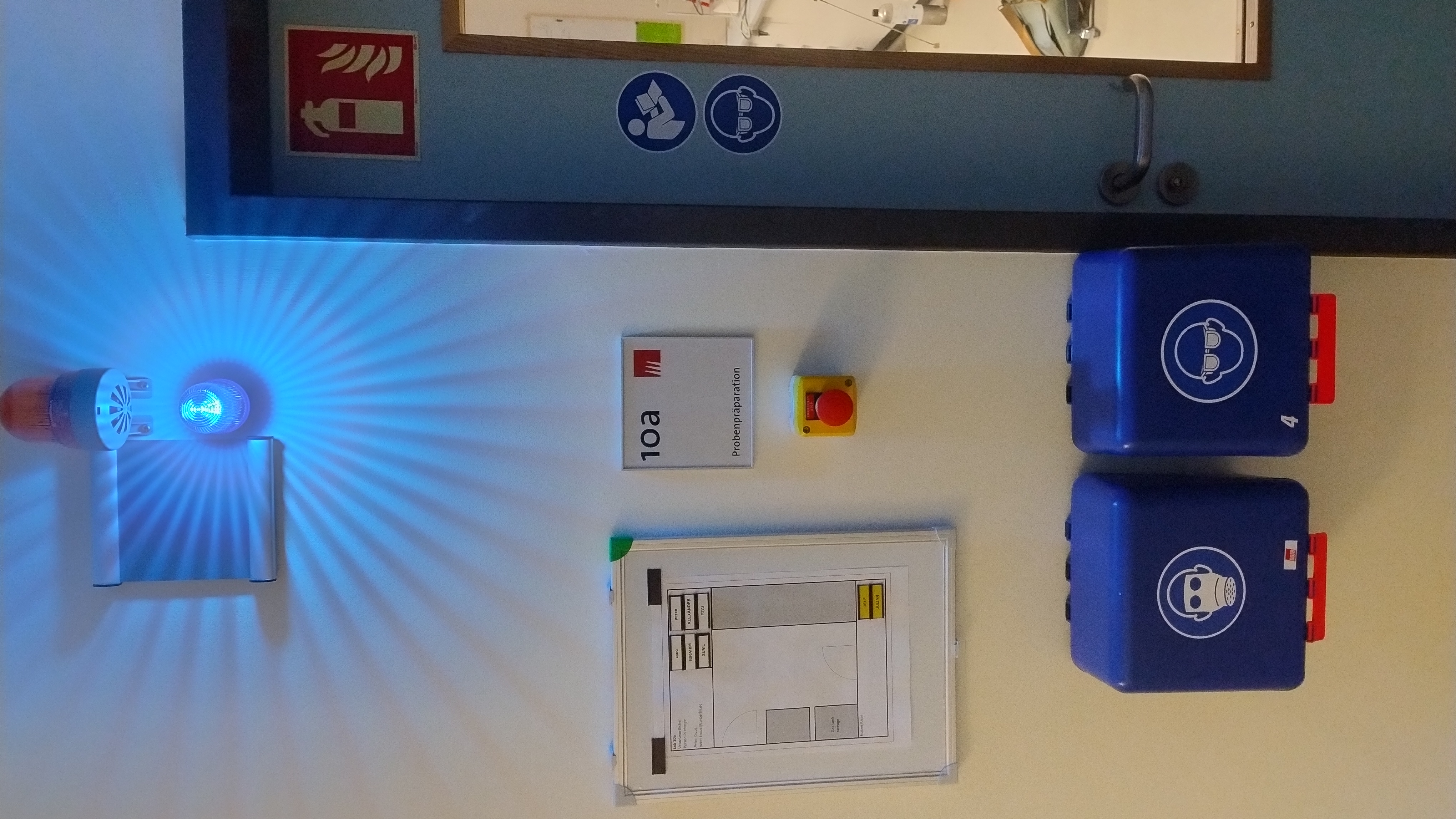
The list of authorized personnel is displayed on the magnet board outside the lab (see Figure 1). It includes only the people with magnets placed on the magnet board outside the lab. If you need a magnet, speak to Delf. Please do not enter the lab if you’re not authorized to do so, except in case of emergencies.
Waste disposal follows the general practices:
- Bin bags should be picked monthly from Zentrale Beschaffung, Gebaude H,6117 Straße des 17. Juni 135 10623 from 07:00 to 13:00 from Monday to Wednesday
- The red bin is for lightly chemically contaminated waste (gloves, paper towels, empty sample holders). The special bags for this bin can be obtained from Ibrahim or Delf.
- The blue bin is for paper and cardboard. No bin bags are used. Emptied by the cleaning staff.
- The black bin is for general waste. The bin bags are replaced by the cleaning staff.
- Larger amounts of plastic and metal should be disposed in the yellow bin in the Hall.
- Glass and sharps waste should be disposed of in appropriate glass bin (Lab 06) and sharps bin (Lab 10a).
For disposal of any amount of toxic waste or larger amounts of chemically contaminated waste, contact Delf.
🥽 Personal protective equipment
Goggles
Safety goggles are to be worn at all times. A set of four is located near the entrance to the lab (see Figure 1).
Lab coats
Clean lab coats are available in the Hall. Since Lab 10a is not a chemical lab, lab coats do not have to be worn when working in the lab. Please use your personal judgement. Do not store your lab coats in the lab, use the coat hooks provided in the corridor outside. Do not store your lab coats in your office.
Gloves
Gloves should be available on the first shelving unit on the right hand side of the lab. If none are available, contact Ibrahim. Do not wear chemically contaminated gloves when handling the control surfaces of instruments, computers, drawers, and door handles. Do not wear gloves for extended periods of time (hours). You should wear gloves when inserting chemicals and samples into instruments, and during clean-up.
Other PPE
- The use of respirators (FFP2 or similar) is recommended when working with loose powders.
- Wear steel-toed shoes when moving large gas cylinders (50 l). You must use a trolley when moving large cylinders for longer distances (> 10 m).
📒 Safety Documentation
The hard-copy safety documentation in Lab 10a includes the following:
- a copy of this manual with a prominent link to the up-to-date online version
- the Lab Log
- a ledger of past weekly, monthly, and annual safety checks
- a copy of the risk assessment (Gefährdungsbeurteilung, GBU) for the lab in its current version,
- a copy of any standard operating procedure (SOP) and/or a risk assessment (GDU) for any mobile instrumentation
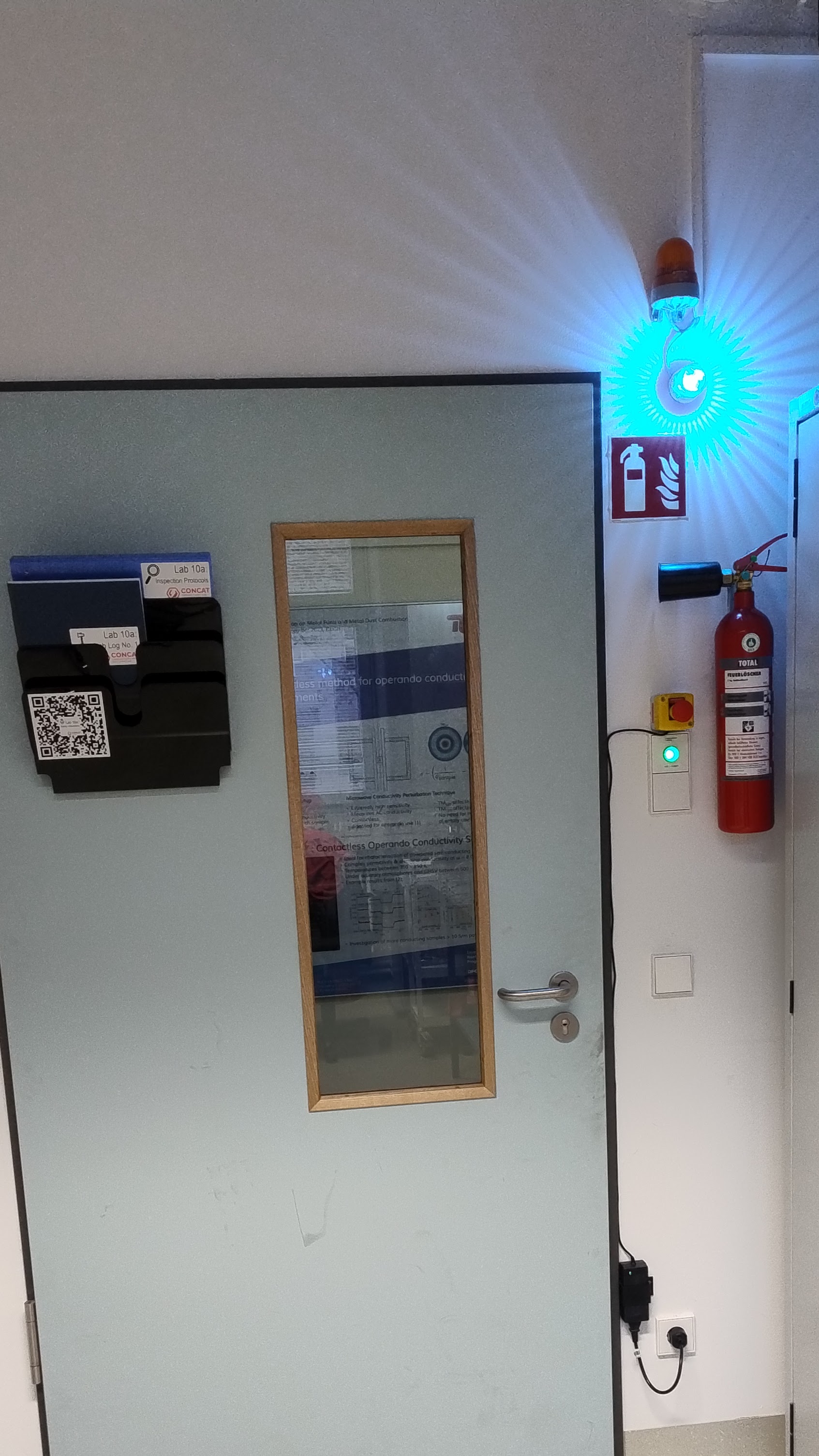
The safety documentation is installed within the lab on the lab door. Further safety-relevant documents, such as the Material Safety Data Sheets (SDS), are in the designated chemical storage cabinet in the lab.
🪓 Lab Log
The Lab Log is a blue notebook, which is part of the hard-copy safety documentation that should be always present in Lab 10a. Do not remove the notebook from the lab. Every change or significant event related to the lab should be entered into the Lab Log, including:
- Modifications to the layout of the lab, e.g. movement of furniture
- Installation of new lab infrastructure, e.g. piping, fittings, sensors, electronics
- Installation of new software or upgrades on the lab PC
- Notes on calibrations and safety checks related to the fixed lab infrastructure
- Removal or installation of mobile instrumentation into the lab
- Safety incidents including near misses, alarms and injuries
- Be written in English if possible, in German if necessary,
- Include the date and time of the event
- Include the name of the person recording the event
- Note any actions necessary (e.g. inform Peter)
🟢 Lab air exchange system
The lab is equipped by a lab air exchange system, currently set to supply and vent about 300 m^3 of air per hour (i.e. > 4\times the air volume of the lab per hour). This system should always be on; this is indicated by the green indicator light on the left-hand side wall as you enter the lab (see Figure 2).
🚨 Gas safety and alarms
A description of the 💨 Gas Systems and 🚨 Alarm Systems installed in the lab is shown on the respective pages. The location of the alarms is shown in in Figure 1 and Figure 2. See also the valid SOPs.